Lecture Notes - CS441

Tuesday, September 24th 2024


  • Compression

  • Lossless vs Lossy

  • Compression is another technique to squeeze more data over a communications line.
  • If you can compress a data file down to one half of it’s original size, file will obviously transfer in less time
  • Lossless: when data is uncompressed, original data returns
  • Lossy: when data is uncompressed, you do not have the original data
  • Lossy example: gray object on gray background, speed is optimized in video when the missing data is generated after video is uncompressed, doesn’t have to deal with every single pixel
  • Preserves the bandwidth.
  • Financial file: lossless is preferrable
  • Video, image, movie, or audio: lossy is okay
  • Lossless compression examples
    • Huffman codes
    • Run-length compression
    • Lempel-Ziv compression
  • Lossy compression examples:
    • MPEG
    • JPEG
    • MP3
  • Error Correction

  • (On midterm)
  • Noise is always present
  • If you had goggles to see electromagnetic waves you’d be able to see a lot of it
  • If a communications line experiences too much noise, the signal will be lost or corrupted
    • Enemy of electrical engineers is noise
    • Mechanical engineers is vibrations
  • Communications systems should check for transmission errors
  • Once an error is detected, a system may perform some action
  • Some systems perform no error control, but simply let the data in the error be discarded
  • Types of Noise

  • White noise

  • Aka thermal or Gaussian noise
  • Relatively constant and can be reduced
  • If white noise gets too strong, it can be completely disrupt the signal
  • Transclude of cs441-lecture-20240924-2024-09-24-13.42.32.excalidraw
  • Impulse noise

  • One of the most disruptive forms of noise
  • Random spikes of power can destroy one or more bits of information
  • Difficult to remove from an analog signal because it may be hard to distinguish from the original signal
  • Can damage more bits if the bits are closer together transmitted at a faster rate)
  • Transclude of cs441-lecture-20240924-2024-09-24-13.46.38.excalidraw
  • Crosstalk

  • Unwanted coupling between two different signal paths
    • Ex: hearing another conversation while talking on the telephone
  • Relatively constant and can be reduced with proper measures
  • Echo

  • The reflective feedback of a transmitted signal as the signal moves through a medium
  • Most often occurs on a coaxial cable – relates to bus topology, without terminators echo would occur at the end of the cable
  • Jitter

  • The result of small timing irregularities during the transmission of digital signals
  • Occurs when a digital signal is repeated over and over
  • If serious enough, jitter forces systems to slow down their transmission
  • Steps can be taken to reduce jitter
  • Delay Distortion

  • Occurs because the velocity of propagation of a signal through a medium varies with the frequency of the signal
  • Can be reduced
  • Attenuation

  • The continuous loss of a signal’s strength as it travels through a medium
  • Why repeaters and boosters exist
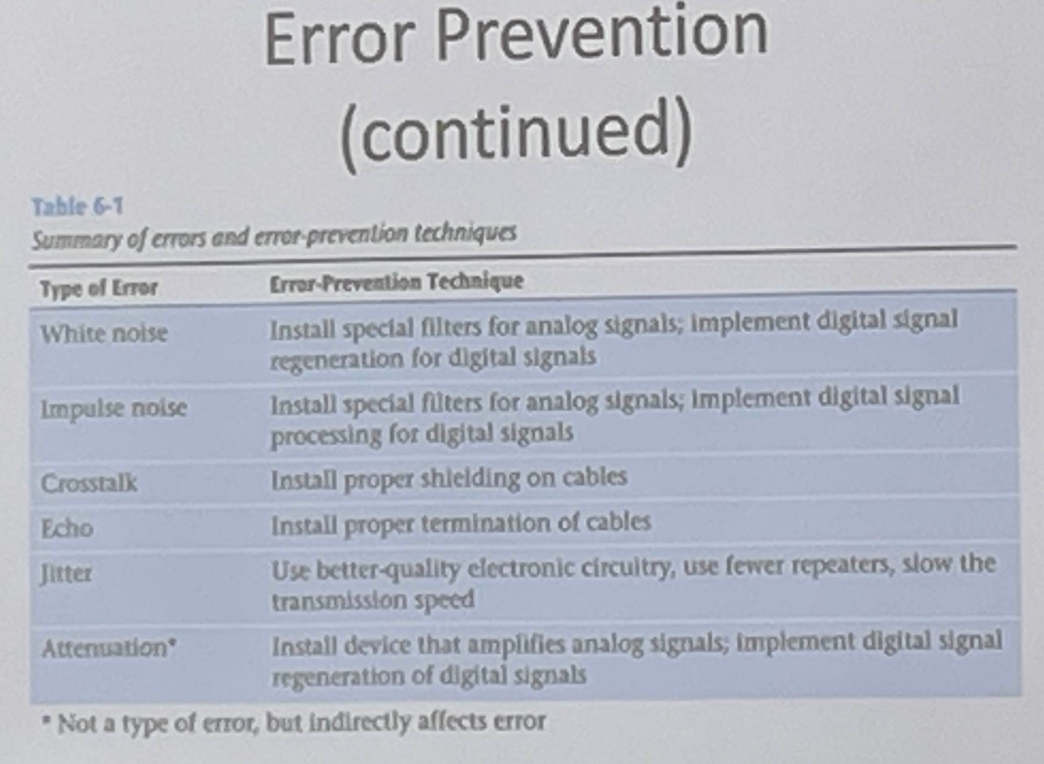
  • Error prevention